
Bangladesh is a
country of rivers, and the lives and livelihoods of millions of people are
closely connected to these waterways. Rivers provide fish, transportation,
water, food, and income for communities across the country. In recent years,
however, rivers have also become spaces for innovative forms of aquaculture.
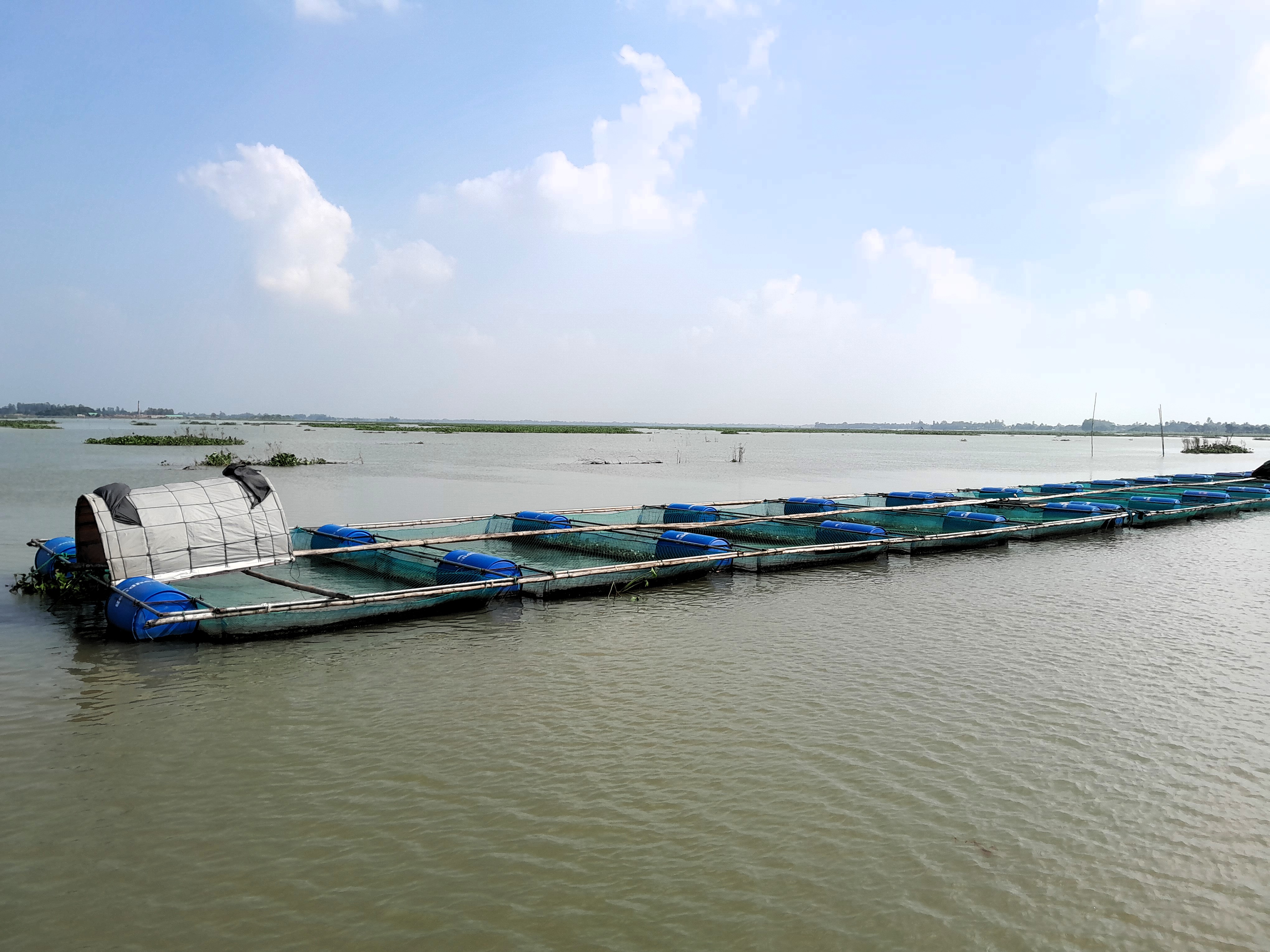
One such practice is cage fish farming, where fish are raised in net cages
installed directly in rivers and other open-water bodies. A notable example of
this emerging practice can be found in Khodalia, Narsingdi, along the Upper
Meghna River.
What is Cage Fish Farming?
Cage fish
farming is a form of aquaculture in which fish are cultured inside net cages
placed in a natural water body. The cage keeps the fish confined while allowing
the surrounding river water to flow freely through the net. Farmers stock
fingerlings in cages, provide feed, monitor fish health and growth, and harvest
the fish when they reach marketable size.
Unlike
conventional pond aquaculture, cage farming does not require farmers to
excavate ponds or use large areas of agricultural land. Instead, the existing
water body becomes the production environment. This makes cage culture
particularly attractive in riverine areas where land availability is limited
but suitable water resources are abundant.
The basic
system is relatively simple, but successful cage farming requires knowledge of
fish biology, feeding, water conditions, cage maintenance, stocking density,
and river dynamics.
Why is Upper Meghna Suitable?
The Upper
Meghna River around Narsingdi provides several favorable conditions for
cage-based fish culture. The continuous movement of river water allows regular
water exchange through the cages and helps maintain suitable oxygen conditions
for fish growth. The availability of open water space also allows farmers to
establish culture units without occupying agricultural land.
At the same
time, the river is a dynamic environment. Water levels, current velocity,
temperature, and other conditions vary throughout the year. Therefore, suitable
site selection is essential. Cage locations need to consider water depth,
current strength, accessibility, navigation, security, and seasonal changes in
river conditions.
The success of
cage culture depends on working with these natural characteristics rather than
trying to control them completely.
Khodalia: A Growing Centre of Cage Fish Culture
At Khodalia in
Narsingdi, cage fish farming has developed into an important local aquaculture
activity. Farmers have established cages in suitable sections of the Upper
Meghna and are using the flowing river water to raise fish commercially.
The practice
provides an alternative to traditional pond-based aquaculture and capture
fishing. Farmers can produce fish directly within the river while maintaining
their connection with the surrounding aquatic environment.
What makes the
Khodalia experience particularly interesting is the scale on which the activity
has developed. What began as relatively small-scale initiatives has gradually
grown into a wider local business sector involving numerous entrepreneurs and
supporting activities.
Monosex Nile tilapia (Oreochromis niloticus): The
Mainstay of Cage Production
Monosex Nile tilapia
is the principal fish cultured in the cage-farming system at Khodalia. Tilapia
has become one of the most widely cultured fish in Bangladesh because of its
relatively fast growth, adaptability, ability to tolerate comparatively high
stocking densities, and strong market demand.
These
characteristics make monosex Nile tilapia well suited to cage culture. Farmers
can stock the fish at appropriate densities and provide formulated feed
throughout the culture period. With proper management, the fish can reach
marketable size within a relatively short period. The strong demand for tilapia
in local and national markets also provides farmers with an established market
for their production.
From Fingerlings to Marketable Fish
The production
cycle begins with the stocking of healthy fingerlings into the cages. Farmers
then provide feed at regular intervals and monitor the fish throughout the
culture period.
Feed management
is particularly important. The amount of feed needs to be adjusted according to
fish size, biomass, feeding response, and environmental conditions. Efficient
feeding helps farmers achieve good growth while reducing unnecessary feed costs
and minimizing the accumulation of organic waste around the cages.
Farmers also
need to inspect the cages regularly. Damaged nets, weak ropes, or problems with
anchoring can result in fish escape and economic losses. Regular observation is
therefore an essential part of cage management.
High Production Potential
One of the
major attractions of cage fish farming is its production potential within a
relatively small area. Based on local experience, a standard cage can produce
approximately 300–400 kg of fish during a four-month culture cycle, depending
on cage size, stocking density, fish survival, feed management, and other
environmental and management factors. With appropriate management and favorable
market conditions, farmers may undertake up to three production cycles in a
year.
This relatively
short production period creates opportunities for repeated harvesting and
income generation. For entrepreneurs, the ability to operate several cycles can
make cage culture an attractive commercial activity.
A New Source of Livelihood
The importance
of cage farming in Khodalia extends beyond fish production. It has become a
source of livelihood diversification for local communities.
People who may
previously have depended primarily on fishing, agriculture, wage labour, or
small businesses can participate in cage aquaculture. Some farmers operate a
small number of cages, while more experienced entrepreneurs have expanded their
operations considerably.
According to
local accounts, more than 350 young entrepreneurs in the area have become
involved in cage fish farming. This indicates that the activity has developed
beyond a simple household-level practice and is becoming an important part of
the local fisheries economy.
Creating a Wider Local Economy
The impact of
cage culture can be seen throughout the local value chain. A cage-farming
operation requires more than fish and water. It requires nets, frames, ropes,
bamboo or other structural materials, fingerlings, feed, boats, labour,
harvesting equipment, transportation, and market connections.
As a result,
cage culture creates opportunities for a range of people, including:
- net makers and repair workers;
- bamboo and cage-material suppliers;
- fish-fingerling suppliers;
- fish-feed dealers;
- cage maintenance workers;
- fish harvesters;
- boat and transport workers;
- fish traders; and
- local retailers.
This creates a
ripple effect throughout the local economy. The benefits of cage farming
therefore extend well beyond the individual entrepreneur who owns the cages.
The Rise of Young Entrepreneurs
One of the most
encouraging aspects of the Khodalia experience is the participation of young
entrepreneurs.
Cage farming
provides an opportunity to build a business using locally available aquatic
resources. Entrepreneurs can start with a limited number of cages and gradually
expand their operations as they gain experience and reinvest their earnings.
Some successful
pioneers in the area reportedly manage up to 150 cages, demonstrating the
potential for cage farming to grow from a small-scale livelihood into a
substantial commercial enterprise. This expansion also creates additional
employment opportunities, as larger operations require more labour for feeding,
monitoring, harvesting, maintenance, transportation, and marketing.
Living with the River
Cage farming in
Khodalia is fundamentally different from pond aquaculture because the farmers
cannot completely control their production environment. The Meghna is a living
and constantly changing system. Its water level rises and falls, currents
change with season and rainfall, and floating debris can travel through the
river. During periods of high flow or flooding, cage structures and anchoring
systems may face considerable pressure.
For this
reason, cage farmers need to understand the river and respond to its seasonal behavior.
Strong cage structures, appropriate anchoring, regular inspection, and careful
site selection are essential. Farmers must also consider navigation and ensure
that cages do not create hazards for boats and other river users. In many ways,
successful cage farming means learning to work with the river rather than
attempting to control it.
Environmental Considerations
The close
connection between cage farming and the natural river environment also creates
environmental responsibilities. Fish feed and waste can contribute to organic
loading around cages if they are not properly managed. Excessive stocking
densities can increase stress and disease risks, while poor cage maintenance
can affect water exchange.
For sustainable
production, farmers need to maintain appropriate stocking densities, avoid
excessive feeding, monitor fish health, maintain cages properly, and select
suitable locations. As cage farming expands, environmental carrying capacity
should also be considered. The number and density of cages in a particular area
should remain compatible with the river's ability to assimilate waste and
maintain water quality. A healthy river is essential for healthy fish and
successful aquaculture.
Challenges Facing Cage Farmers
Despite its
potential, cage fish farming is not without challenges.
Strong currents
and flooding can damage cages and anchoring systems. Fish diseases and
mortality can reduce production. Feed prices can affect profitability, while
fluctuations in fish market prices can influence farmers' returns.
There are also
risks associated with theft, predators, cage damage, and accidental fish
escape.
Climate
variability may add further uncertainty. Changes in rainfall, water levels,
temperature, and extreme weather events can affect cage operations and
production.
Addressing
these challenges will require improved technical knowledge, better cage
technology, access to quality fingerlings, responsible fish health management,
and stronger institutional and extension support.
Opportunities for Sustainable Development
The Khodalia
experience shows that cage aquaculture has significant potential as a
livelihood and business activity in riverine Bangladesh. However, future
development should focus not simply on increasing the number of cages but on
improving the efficiency, profitability, safety, and environmental
sustainability of existing systems. Several measures could support this
development, including improved cage designs, stronger anchoring systems,
better-quality fingerlings, efficient feeding practices, farmer training, fish
health services, access to affordable finance, improved market linkages, and
regular environmental monitoring. Technical support could also help farmers
improve production while reducing feed wastage, fish mortality, and operational
risks.
A River-Based Business Model
The Khodalia
case demonstrates an interesting model of rural entrepreneurship. The river
provides a production environment. The cage provides a controlled culture
space. Farmers provide investment and management. Feed suppliers, fingerling
traders, transport workers, and fish markets provide a supporting network. Together,
these elements create a complete economic system around cage aquaculture.
The model is
particularly relevant for Bangladesh because the country possesses extensive
river and open-water resources but faces increasing pressure on agricultural
land. Cage culture offers a way to increase fish production without necessarily
converting additional land into ponds.
The Future of Cage Fish Culture in Khodalia
The future of
cage fish farming in Khodalia will depend on maintaining a balance between
production, profitability, and environmental protection. The Upper Meghna is a
shared resource. It supports fish biodiversity, navigation, local livelihoods,
transportation, and many other activities. Cage farming must therefore develop
in a way that considers the interests of other river users and protects the
ecological health of the river.
If appropriate
technology, technical knowledge, environmental safeguards, and market
opportunities are available, cage culture can continue to contribute to local
livelihoods and fish production. The experience of Khodalia also provides
lessons that may be relevant to other riverine communities across Bangladesh.
Farming with the River
The story of
cage fish culture in Khodalia is ultimately a story about adaptation,
innovation, and entrepreneurship. For generations, people have depended on the
Meghna for fish and livelihoods. Today, some are taking that relationship a
step further by farming fish directly within the river.
The floating
cages may appear small against the vast expanse of the Upper Meghna, but their
impact is much larger. They provide fish for markets, income for farmers,
employment for workers, and opportunities for young entrepreneurs. Most
importantly, the Khodalia experience demonstrates that a river can be more than
a source of naturally occurring resources. With appropriate management, it can
become a productive space for sustainable livelihood development.
Khodalia's story is simple but powerful:
when communities learn to farm with the river, the river can become not only a
source of fish, but also a source of livelihoods and opportunity.
Share this page via
More from Md. Ariful Haque Rupom